Unraveling the Legends of Castle Sinclair Girnigoe: A History Rewritten
Nestled on the dramatic cliffs of Scotland's far north, Castle Sinclair Girnigoe holds centuries of tales, blending brutal history with enduring myth. As...
- Scotland Tours
- 6 min read
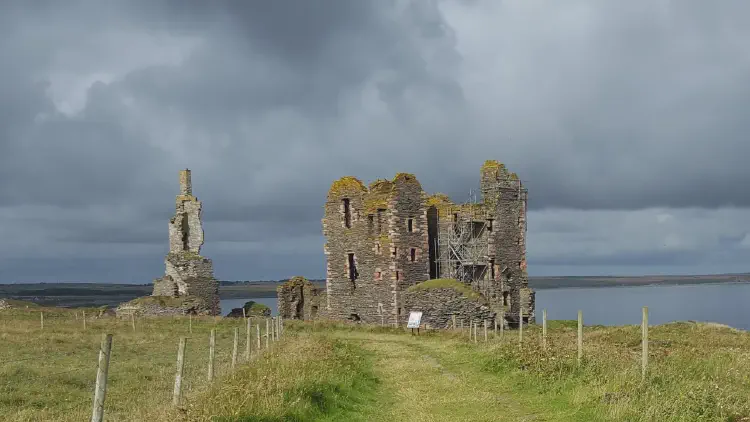
The Legends of Castle Sinclair Girnigoe: A History Rewritten
Nestled on the dramatic cliffs of Scotland’s far north, Castle Sinclair Girnigoe holds centuries of tales, blending brutal history with enduring myth. As ongoing archaeological work unearths new secrets, the story of this formidable stronghold is constantly being reshaped, separating long-held legends from historical fact. Join us as we delve into the turbulent history of one of Caithness’s most iconic ruins.
The history of Castle Sinclair Girnigoe in Caithness is a narrative in flux. For years, its story was built on a foundation of local lore and initial historical assessments. However, as further excavations take place on the site, new information is constantly coming to light, challenging old assumptions and dispelling some of the most persistent myths surrounding the castle and its infamous inhabitants.
Originally, it was thought that the castle was constructed around the end of the 15th century, with significant additions made in the 1600s. Local stories offered dramatic explanations for its ruined state. One tale tells of its destruction by cannon fire during the latter part of that century when George Sinclair of Keiss stormed it. Another suggests it was simply abandoned after Oliver Cromwell’s troops attempted to destroy it, leaving it to fall into disrepair.
The first definitive written account of the building’s existence came from notes made by a clergyman named John Brand in the 1700s. During his visit, he documented that the once-mighty castle was already in a state of ruin, providing a crucial historical benchmark for understanding its timeline.
It is known that over its lifetime, the castle underwent significant changes. Additions and alterations were made periodically, either to bolster its defenses against military threats or simply to keep up with the changing architectural fashions of the era. Whatever the reason for these modifications, its active use had ceased by the time of Brand’s visit, marking the end of its chapter as a functional fortress.
In recent years, modern excavations have revealed a more complex story. Archaeologists have unearthed more walls than were previously known to exist and discovered the foundations of other buildings on the site. This new evidence has prompted a major reassessment of the castle’s origins.
The best guess now is that it was built at least a hundred years before what had originally been thought.
Perhaps the most infamous figure associated with the castle is George, the fourth Earl of Caithness. His ruthless reputation has spawned numerous dark legends.
Legend has it that George was a cruel patriarch who not only imprisoned his firstborn son, John, in the castle’s dark and dismal dungeon but also callously set brother against brother, fostering deadly rivalries within his own family.
One dramatic tale recounts how John’s brother, William, entered the dungeon, intending to kill him. However, John was ready for a fight and ultimately killed William. Despite this, John did not escape; other jailers were sent to guard him, but they eventually abandoned him to his fate. The reason for his imprisonment remains shrouded in mystery. Some historians believe it was because he lacked his father’s brutal nature, while others suggest he had started a rebellion against him.
Another gruesome legend claims that George tormented his imprisoned son by feeding him only salted beef and refusing him water, leading to an agonizing death from thirst.
However, like many legends, this one crumbles under scrutiny. In fact, historical family papers reveal a different story: John actually escaped his imprisonment and died later in his own home in 1575 at the age of 32.
George, the 4th Earl, was known for his contentious nature, causing a feud that lasted over a century with the neighboring Mackays of Strathnaver and the Gordon Earls of Sutherland. His notoriety was fueled by several incidents, including his decision to ignore the poisoning of the Earl and Countess of Sutherland at Helmsdale Castle in 1567 by his relative, Isabel Sinclair. He was also alleged to have abducted the 15-year-old 11th Earl of Sutherland in an attempt to force a marriage with his own 32-year-old daughter.
George was also a key figure in the trial of James Hepburn, Earl of Bothwell, the lover of Mary, Queen of Scots.
Bothwell had been accused of having a hand in the murder of Mary’s husband, Henry Stuart, Lord Darnley, in 1567—an event famously known as the Kirk o’ Field mystery.
After a massive explosion destroyed the house in Edinburgh where Darnley was staying, the bodies of Darnley and his valet were discovered in the garden. Both men had been strangled. Suspicion immediately fell on Bothwell, and though he was widely considered guilty by the public, he was controversially acquitted in a trial in which George Sinclair played a part.
Between 1566 and 1572, George built Barrogill Castle at Mey, another status symbol to add to his collection. This castle would later find new fame when it was purchased by Queen Elizabeth The Queen Mother in 1952 and became known as the Castle of Mey. George, the 4th Earl, died in 1582 in Edinburgh, and his body was taken to be interred at the famous Rosslyn Chapel in Midlothian.
The Sinclairs’ tumultuous history continued with George, the fifth Earl of Caithness, known as the “Wicked Earl.” He was the grandson of the first George and son of the imprisoned John. Legend claims he took revenge for his father by having the jailers who guarded him at Castle Sinclair Girnigoe killed.
By the time of his death in 1643, the Wicked Earl was bankrupt. He had spent his fortune on his castles and estates, even resorting to making counterfeit money to fund his lifestyle. He sold off lands, including Barrogill Castle in 1606, but his debts continued to mount. Another story tells of him getting Orcadian mariners drunk, shaving their heads, and setting them adrift off the Caithness coast, though it is difficult to know if this is legend or fact.
The next heir, George, sixth Earl of Caithness, married Lady Mary Campbell, daughter of the powerful Archibald Campbell, 1st Marquess of Argyll. When he died without an heir in 1676 at Thurso Castle, his lands, which had been mortgaged, passed into the possession of his father-in-law’s family. His widow married Sir John Campbell of Glenorchy, who then laid claim to the lands and proclaimed himself Earl of Caithness.
This did not sit well with the Sinclairs. Unhappy with this turn of events, George Sinclair of Keiss stormed the castle in 1679 to reclaim it but was repelled by Campbell’s forces. He tried again in 1690, and this time he was successful. However, the battle all but destroyed the building, leaving it in the ruined state we see today. After his victory, George Sinclair of Keiss proclaimed himself the 7th Earl of Caithness.
Based on the evidence gathered so far, the popular story involving Cromwell’s troops appears to be untrue. At Castle Sinclair Girnigoe, fact and fiction are deeply entwined, and separating the two is a constant challenge for historians. Yet, as with most enduring legends, there is often a kernel of truth buried within the tales. Whatever is true, the Sinclair legends will endure, regardless of the ever-changing history and new evidence coming to light. Castle Sinclair Girnigoe still stands proud on the rocky clifftop overlooking the vast bay, and that is a fact.
In 2018, visitor access to the castle became easier and safer thanks to the installation of a new footbridge, allowing more people to walk among these historic ruins. With careful attention and ongoing preservation, it will hopefully remain a significant part of the Caithness landscape for another 500 years or more.